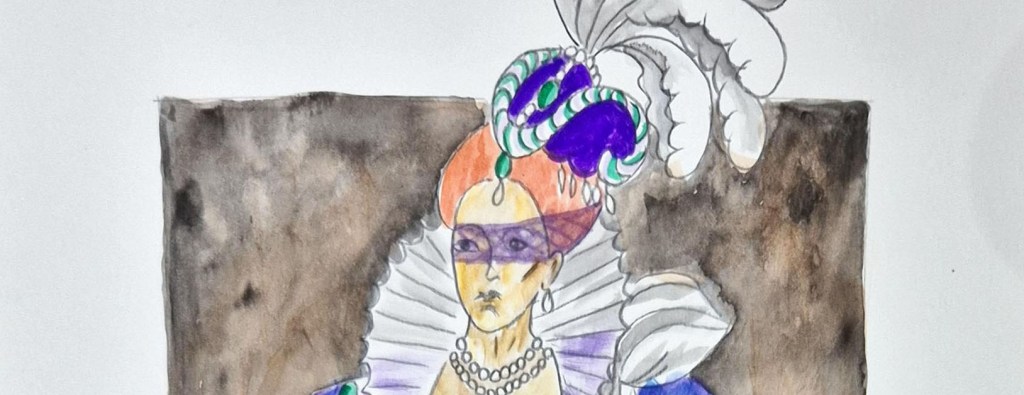
We were asked to design costumes for characters from Romeo and Juliet. I chose Julien (Juliet) and Paris, although I reimagined Juliet as a man and Paris as a woman. This allowed me to explore ideas around gender identity and sexual preferences within the play, while also giving me the opportunity to design for what I imagined as a wealthy and somewhat privileged noblewoman. I also enjoyed the idea of reversing the traditional dynamic so that Paris the woman was chasing Julien the man.
I chose to focus on the ballroom scene and interpreted the setting as an Elizabethan masque. This seemed particularly appropriate because Elizabethan masques were elaborate performances in which members of the nobility could participate directly, allowing characters and performers to take on exaggerated or mythological identities. This provided an opportunity to move beyond simply recreating historical dress and instead explore the theatrical possibilities of costume.
My research was extensive. I looked at Elizabethan masques, the work of Inigo Jones, who designed scenery and costumes for the court of James I, and contemporary paintings depicting Elizabethan figures and what scholars suggest may have been masque costumes. The amount of research eventually became somewhat excessive, but it also became one of the most enjoyable aspects of the project. I found myself discovering ideas and connections that I had not previously considered.
One of the most significant things I learned was that historical costume cannot necessarily be treated as a fixed representation of a particular period. Elizabethan masques, much like Hollywood costume productions of the 1950s, combined historical or mythological references with contemporary fashion. The Elizabethans could incorporate elements of Roman mythology while still using the silhouettes, fabrics and decorative conventions of their own time. This became an important principle in my design approach.
From this research, Julien developed into an interpretation of Apollo, the sun god, while Paris became Diana, the huntress. I also explored the representation of the female body in Elizabethan court dress, including contemporary reactions to the revealing fashions associated with Queen Elizabeth I. This led me to consider a more provocative interpretation of Paris, including the use of a partially exposed breast as part of the design.
Ultimately, I wanted the costumes to communicate the wealth, status and extravagance of the nobility, while also reflecting the excessive resources that could be devoted to court entertainment. Combining historical research with mythology and my own interpretation of the characters allowed me to create costumes that were rooted in the period while still feeling theatrical and deliberately larger than life.
Although the designs appear highly ornate, I also considered how they could be practically realised for the theatre. Paris’s costume could be constructed using luxurious-looking materials such as velvet, silk organza and pearls. Traditional embroidery would create a historically appropriate and richly decorative finish, but it would also be extremely time-consuming. Fabric painting could provide an alternative method of achieving a similar visual effect in considerably less time, which is an important consideration within the practical constraints of theatre production.
Julien’s costume, although equally elaborate in appearance, could also be approached using relatively accessible construction techniques and materials. The breastplate and helmet could be created from EVA foam, while the cloak could be made from satin and the breeches decorated with velvet and stitched-on jewels. This reinforced another important consideration for me: a costume does not necessarily need to be constructed from expensive or complicated materials to appear elaborate on stage. Through careful choice of materials, surface decoration and construction methods, it would be possible to recreate the overall effect without the process being particularly difficult or impractical.
In the end I was pleased with my 2 designs.
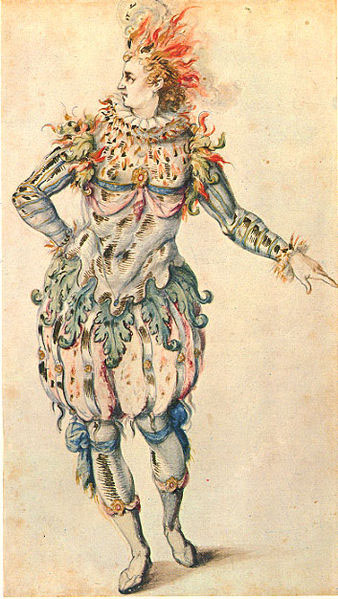
A Star by Inigo Jones 1609
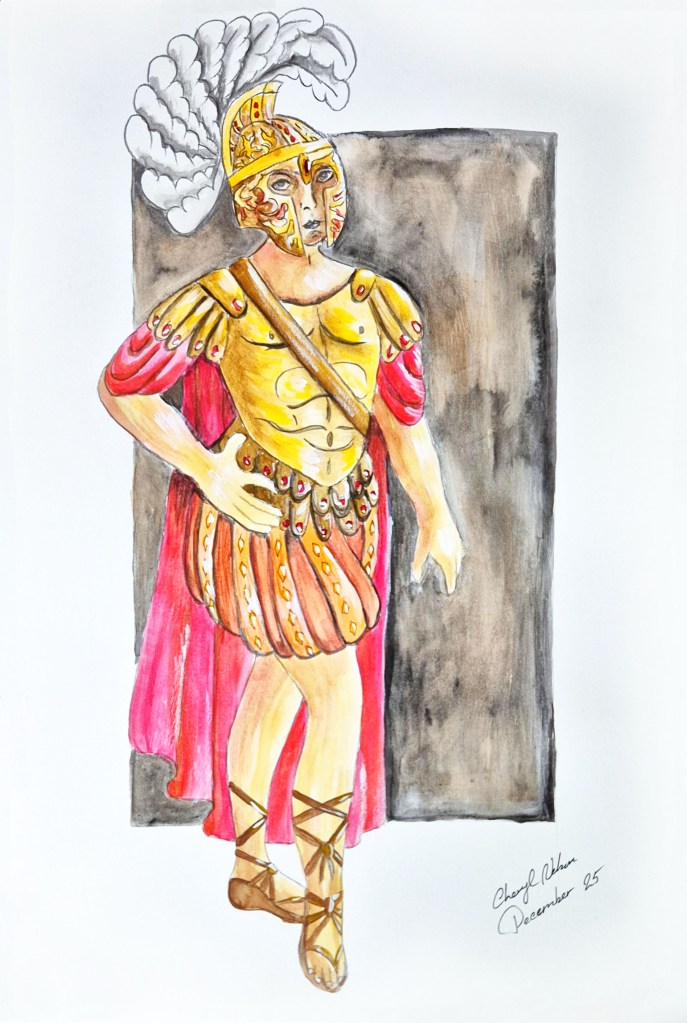
Julien Cheryl Nelson 2025
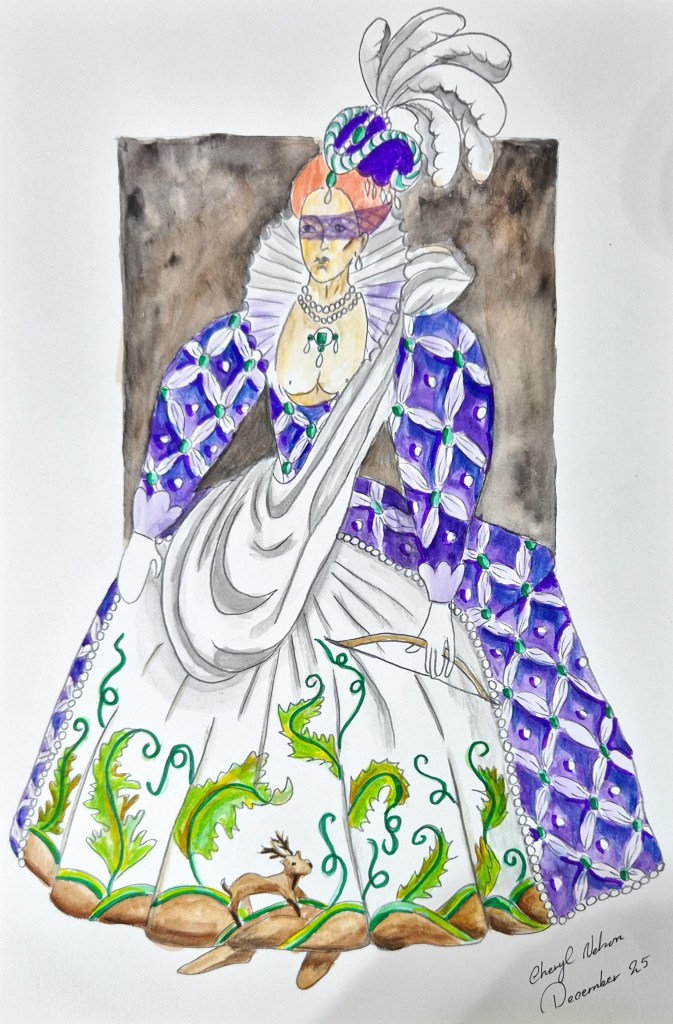
Paris Cheryl Nelson 2025


Leave a comment