One of the most difficult questions we faced was how to create a film that responded to the material surrounding the Epstein case and its representation in the media. How could we communicate the scale of the abuse, the mechanisms of grooming and the power relationships involved without simply reproducing what had already been reported?
Our solution was to reduce the subject to what we saw as one of its central themes: grooming and the way it can spread from one victim to another. We began to think of this almost as a form of infection. One girl, brought into the situation under false pretences, could be used to attract or recruit another. In our interpretation, the process transformed victims into participants within the same cycle, creating a disturbing chain in which predatory behaviour was repeatedly passed on.
I wanted to represent the people responsible for initiating this process as monstrous figures, while also showing how their actions could transform those they targeted. The “monster” therefore became a metaphor for predatory behaviour itself: something that approaches the vulnerable, disguises its intentions and perpetuates the cycle.
An important part of our concept was that this process should not appear openly. Grooming can take place beneath an apparently ordinary surface, hidden in plain sight. We therefore decided to film the piece as though it were captured by an unmanned surveillance camera, creating the impression that the viewer was witnessing something without fully understanding its context.
We filmed in Plymouth city centre, where the public largely continued with their everyday activities around us. For our purposes, this became an important part of the work. The activity was visible, yet largely unnoticed, reinforcing our idea of something disturbing happening in plain sight while everyone continued to go about their normal lives.
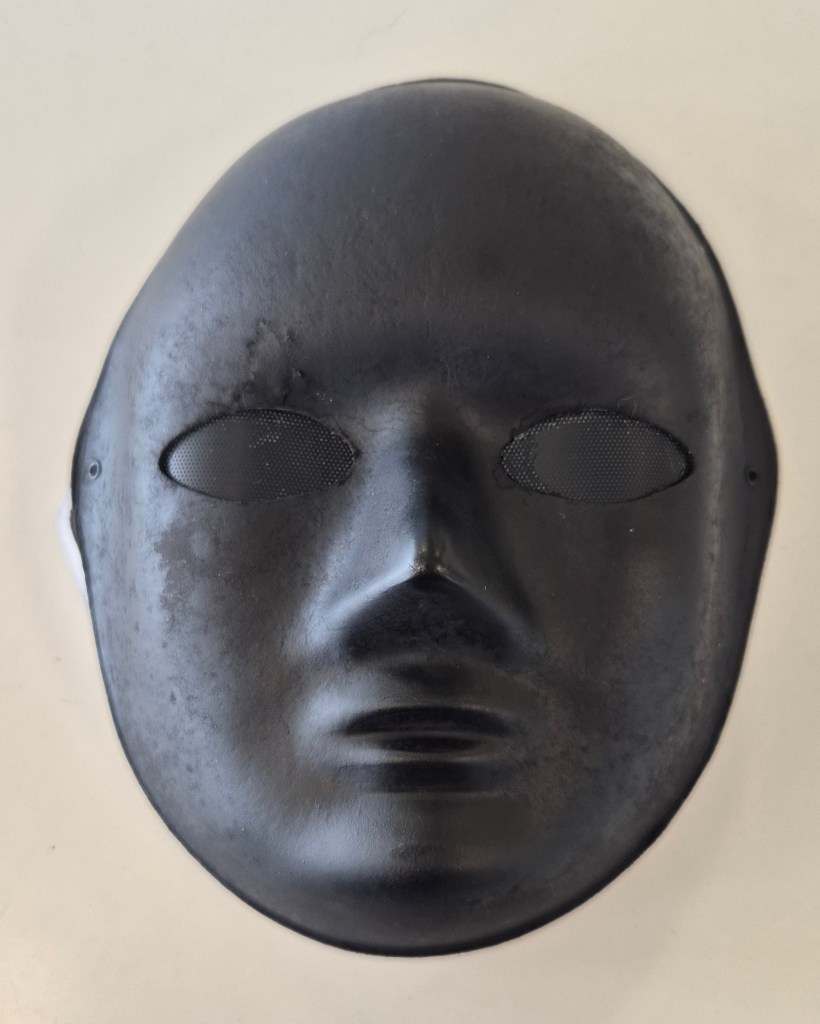
As a group, we each created our own interpretation of a “monster”. The main element we shared was the use of a mask, representing the concealment of identity and the separation between outward appearance and hidden behaviour.
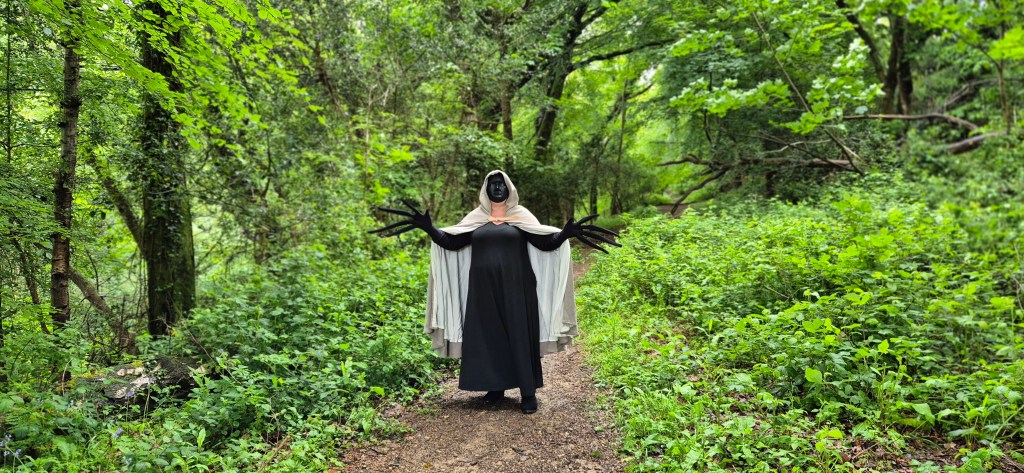
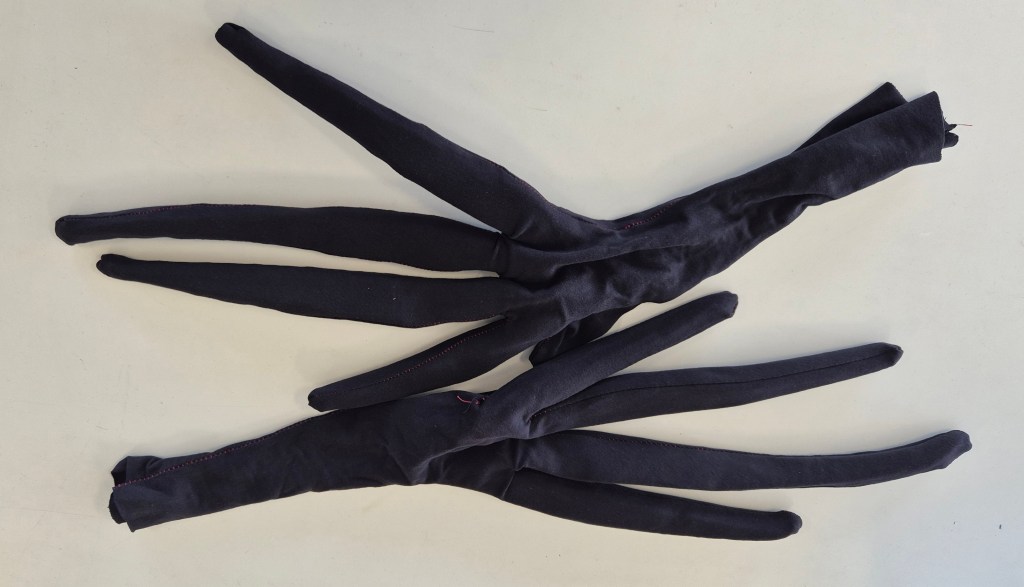
For my own monster, I wanted to represent a void: something dark, empty and constantly seeking. I used long fingers to suggest reaching and taking, a cloak to provide concealment, and a completely black face to remove any sense of individuality or emotion. The figure was intended to communicate my perception of predatory behaviour as something devoid of empathy or humanity.
The structure of the film developed around a repeated cycle. Each of us approached a victim while dressed as our monster. We then slowly removed the costume, revealing an apparently ordinary person, before sitting beside the victim. After the “infection” had taken place, the victim stood and walked away. The following sequence revealed that person as the next monster, continuing the same process with another victim. The repetition created a visual chain, suggesting how abuse can become cyclical and how the effects of one act can extend far beyond the original encounter.
Stylistically, I wanted the film to combine surrealism and symbolism with elements of Dadaism. Dada emerged partly as an artistic response to the perceived irrationality and destruction of war, and I was interested in making a similar connection to what I saw as the disturbing contradictions surrounding power, influence and accountability in this case. Rather than attempting to recreate real events literally, we used distorted imagery and symbolism to communicate an emotional and conceptual response.
The decision to work symbolically was important to me. The documentary and media coverage surrounding the case contains an enormous amount of material, and the US Department of Justice has released millions of pages of records while continuing to maintain an Epstein Library that can be updated if additional documents are identified. Our intention, however, was not to reproduce that material but to distil our response to it into a visual metaphor. The resulting film therefore became less about representing individual events and more about exploring the ideas of concealment, predatory behaviour, power and the way an abusive system can perpetuate itself.
The subject also remains ongoing. Further documents continue to be examined and released, while congressional scrutiny and legal action connected to Epstein’s associates are still taking place. At the time of writing, however, there have been no publicly announced federal prosecutions of other individuals simply on the basis that their names appear in the released files. This distinction is important: being named in records does not, by itself, establish that a person committed a crime. For me, the continuing uncertainty and lack of a simple conclusion reinforces the central idea behind our film. The sense of something unresolved, obscured and still developing beneath the surface.


Leave a comment